
Blog
🧬 BPC‑157 vs TB‑500: The Healing Peptide Showdown of 2026

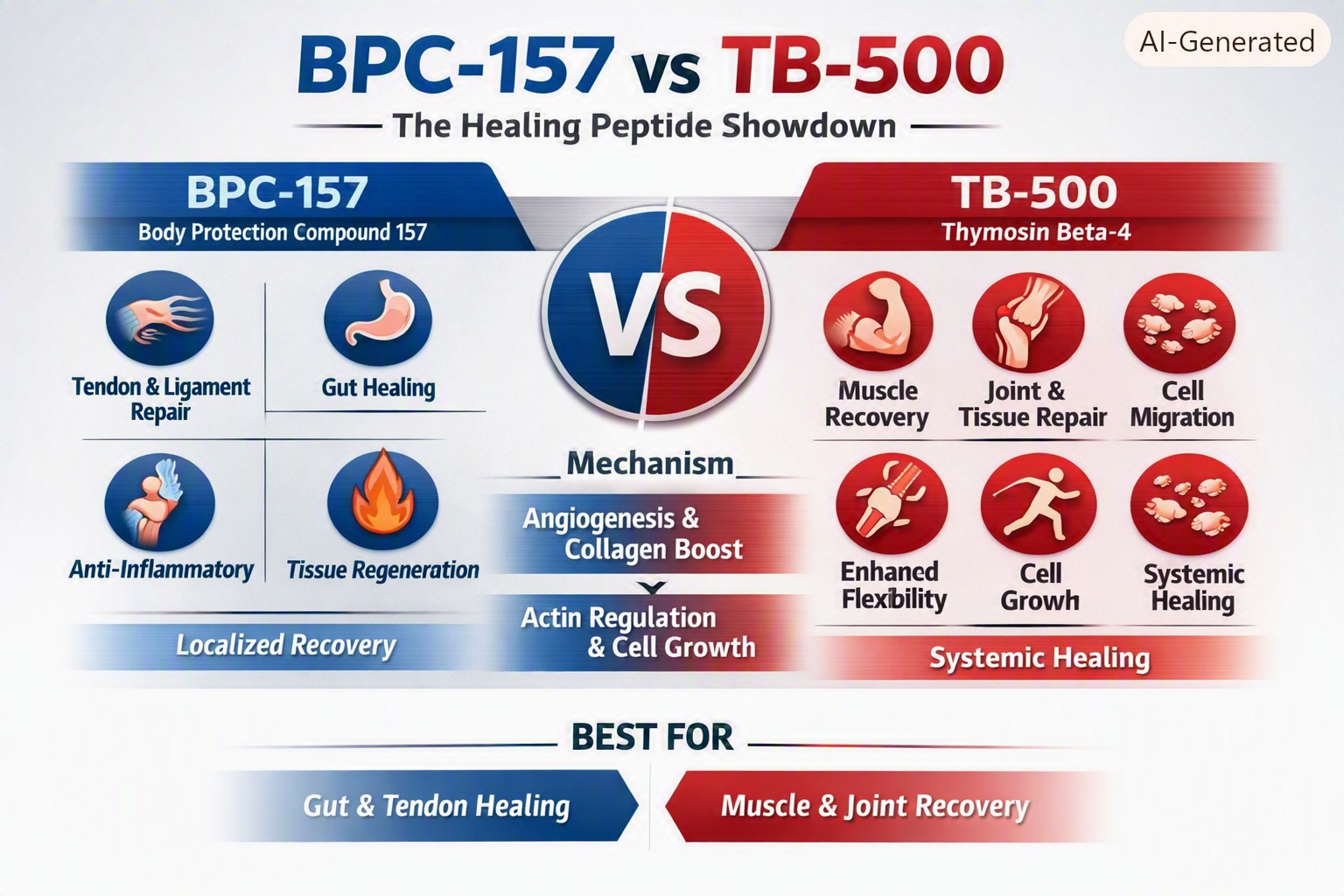
BPC‑157 vs TB‑500 is one of the most searched comparisons among researchers, athletes, and biohacking enthusiasts in 2026. Both peptides are widely discussed for their potential roles in tissue repair, muscle recovery, and injury management. While they share similar goals, they work through different biological mechanisms and may be better suited for different types of research applications.
This guide compares BPC‑157 vs TB‑500, covering their mechanisms, benefits, differences, similarities, and research applications.
🧬 What Is BPC‑157?
BPC‑157 (Body Protection Compound‑157) is a synthetic peptide derived from a naturally occurring protective protein found in the stomach. It has become a popular research peptide due to its potential effects on tissue repair and recovery.
Research suggests BPC‑157 may support:
- Tendon and ligament recovery
- Muscle repair
- Gut health research
- Blood vessel formation (angiogenesis)
- Anti‑inflammatory activity
Scientists continue investigating its role in improving healing after soft tissue injuries.
💪 What Is TB‑500?
TB‑500 is a synthetic version of Thymosin Beta‑4, a naturally occurring peptide found throughout the body. It is being studied for its potential ability to promote cell migration, tissue regeneration, and wound healing.
Research focuses on its possible benefits for:
- Muscle recovery
- Joint support
- Connective tissue repair
- Flexibility and mobility
- Recovery following physical stress
Unlike BPC‑157, TB‑500 may have broader systemic effects because it circulates throughout the body.
⚙️ Head‑to‑Head Comparison
| Peptide | Primary Benefit | Best Use Case |
|---|---|---|
| BPC‑157 | Gut healing, tendon repair | Digestive health, localized injuries |
| TB‑500 | Muscle recovery, systemic healing | Athletic recovery, performance support |
🔗 Similarities Between BPC‑157 and TB‑500
Although different, both peptides share several characteristics. They are commonly researched for:
- Tissue regeneration
- Injury recovery
- Reduced inflammation
- Improved healing
- Recovery after intense exercise
Researchers often compare them because both may contribute to faster recovery through different biological pathways.
BPC‑157 vs TB‑500 Which Peptide Is Better?
There is no universal winner in the BPC‑157 vs TB‑500 debate.
- BPC‑157 may be preferred for studies focusing on:
- Tendon injuries
- Ligament damage
- Gut tissue research
- Localized healing
- TB‑500 may be preferred for research involving:
- Muscle recovery
- Whole‑body healing
- Connective tissue regeneration
- Flexibility and mobility
The best choice depends entirely on the goals of the research.
🧩 Can They Be Studied Together?
Some researchers investigate BPC‑157 and TB‑500 together because they may work through complementary biological mechanisms. However, more scientific research is needed to fully understand their combined effects. Any combination should only be explored within appropriate laboratory research settings.
📊 Current Research
Scientific interest in both peptides continues to grow. Researchers are studying:
- Muscle regeneration
- Wound healing
- Tendon repair
- Bone healing
- Inflammation
- Recovery following physical stress
While early findings are promising, many studies remain preclinical, and further research is needed to better understand their safety and effectiveness.
⚠️ Safety Considerations
- Both peptides are generally sold for laboratory research purposes.
- They are not approved as medicines in many countries.
- Much remains unknown about their long‑term effects in humans.
- Researchers should always follow applicable regulations and ethical guidelines.
🧩 Frequently Asked Questions
- Is BPC‑157 stronger than TB‑500? They serve different research purposes. BPC‑157 is often studied for localized tissue repair, while TB‑500 is commonly researched for broader tissue regeneration.
- Can researchers compare both peptides? Yes. Comparing BPC‑157 vs TB‑500 is common in scientific literature because they have different mechanisms of action.
- Which peptide supports tendon research? BPC‑157 is frequently investigated in tendon and ligament research.
- Which peptide supports muscle recovery research? TB‑500 is often studied for muscle recovery and connective tissue regeneration.
🎯 Conclusion
The BPC‑157 vs TB‑500 comparison remains one of the most important discussions in peptide research. Both compounds show promising potential in preclinical studies involving tissue repair and recovery, but they function differently and may be suitable for different research objectives.
As scientific understanding continues to evolve, these peptides are likely to remain a major focus in regenerative medicine and laboratory research.
📈 Why They’re Trending in 2026
- Biohackers use them in recovery stacks.
- Longevity researchers explore their role in anti‑inflammatory pathways.
- Athletes experiment with peptide cycles for faster rehab.
- SEO traffic drivers: searches for “BPC‑157 vs TB‑500” and “best healing peptides 2026” are surging globally.
⚠️ Safety & Regulation
- FDA status: Neither peptide is FDA‑approved for general medical use.
- Risks: Limited human trials, sourcing concerns, and potential side effects.
- Best practice: Always consult a licensed clinician before considering peptide therapy.
🎯 Final Word
The BPC‑157 vs TB‑500 debate defines peptide research in 2026. While both show promise in healing and recovery, their roles differ: BPC‑157 shines in gut and tendon repair, while TB‑500 excels in muscle regeneration and systemic recovery. Together, they represent the cutting edge of experimental peptide therapy.