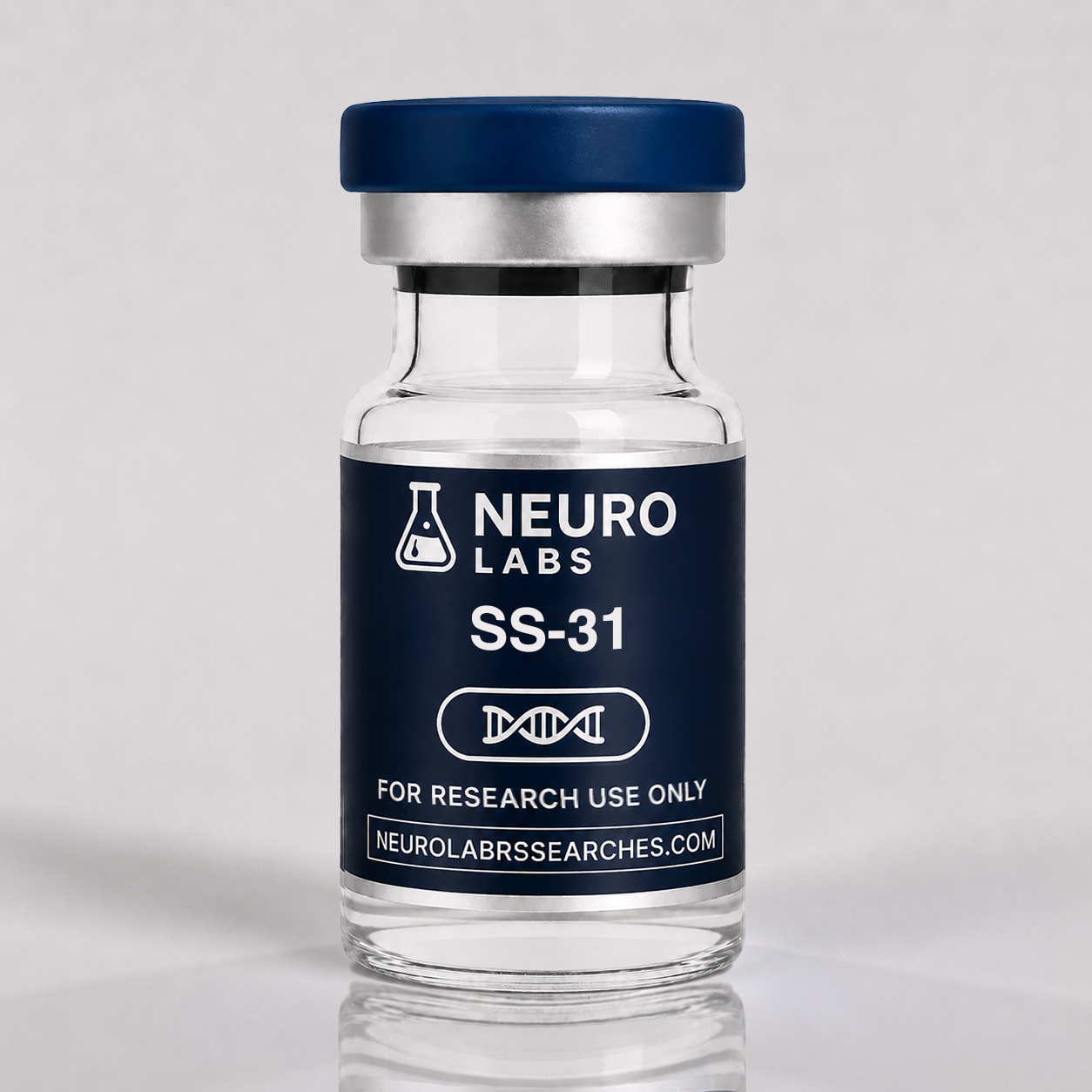
SS-31 ™
$120.00 – $472.00Price range: $120.00 through $472.00
SS-31 ™ (Elamipretide) is a mitochondria‑targeted peptide recently FDA‑approved (September 2025) for Barth syndrome, with growing off‑label interest in heart failure, neurodegeneration, and longevity medicine. It works by binding cardiolipin in the inner mitochondrial membrane, stabilizing energy production, reducing oxidative stress, and improving ATP output.
What Is SS‑31™ (Elamipretide)?
- Type: Cell‑penetrating tetrapeptide (D‑Arg‑2′6′‑Dmt‑Lys‑Phe‑NH₂).
- Mechanism: Binds cardiolipin → stabilizes mitochondrial cristae → reduces ROS → enhances ATP output.
- FDA Status: Approved September 2025 for Barth syndrome under the brand name Forzinity.
- Other Names: MTP‑131, Bendavia, Elamipretide.
Description
SS-31 ™
SS-31 ™ (Elamipretide) is a mitochondria‑targeted peptide recently FDA‑approved (September 2025) for Barth syndrome, with growing off‑label interest in heart failure, neurodegeneration, and longevity medicine. It works by binding cardiolipin in the inner mitochondrial membrane, stabilizing energy production, reducing oxidative stress, and improving ATP output.
What Is SS‑31™ (Elamipretide)?
- Type: Cell‑penetrating tetrapeptide (D‑Arg‑2′6′‑Dmt‑Lys‑Phe‑NH₂).
- Mechanism: Binds cardiolipin → stabilizes mitochondrial cristae → reduces ROS → enhances ATP output.
- FDA Status: Approved September 2025 for Barth syndrome under the brand name Forzinity.
- Other Names: MTP‑131, Bendavia, Elamipretide.
SS-31 ™ Benefits
Clinical & Research Benefits
- Mitochondrial stabilization: Preserves cristae structure and electron transport chain function.
- Energy production: Increases ATP output, improving muscle strength and endurance.
- Oxidative stress reduction: Lowers ROS levels, protecting cells from damage.
- Cardiac support: Improves exercise tolerance in heart failure patients.
- Neuroprotection: Potential benefits in neurodegenerative diseases.
- Longevity research: Investigated for age‑related mitochondrial decline.
⚖️ Dosage & Administration
- FDA‑approved dose: Subcutaneous injection for patients ≥30 kg with Barth syndrome.
- Research dosing:
- Subcutaneous: 0.1–2 mg/kg daily.
- Intravenous infusion: 0.01–0.25 mg/kg/h over 4 hours (used in clinical trials).
- Duration: Clinical studies range from 4 weeks to 168 weeks (long‑term open‑label extensions).
Side Effects & Safety
- Common: Mild injection‑site reactions, headaches.
- Rare: Aspiration pneumonia, appendicitis, vasovagal episodes (linked to underlying disease, not drug).
- Long‑term safety: Well tolerated in open‑label extensions up to 168 weeks.
- Abuse potential: None; not a controlled substance.
Availability & Cost
- FDA‑approved: Available under brand name Forzinity for Barth syndrome.
- Off‑label use: Longevity clinics and cardiology practices exploring applications in HFpEF, mitochondrial myopathy, AMD, and neurodegeneration.
- Cost: Typically $500–$1200/month depending on provider and formulation.
📊 Expanded Comparison – SS‑31™ vs Other Mitochondrial Interventions
SS‑31™ (Elamipretide) is unique among mitochondrial therapies because it directly binds cardiolipin, stabilizing the inner mitochondrial membrane and restoring energy production. To appreciate its role, let’s compare it with other interventions using more advanced scientific terminology and long‑form descriptions.
SS‑31™ (Elamipretide)
- Mechanism of Action: A mitochondria‑penetrating tetrapeptide that selectively associates with cardiolipin, thereby preserving cristae morphology, stabilizing electron transport chain complexes, and reducing reactive oxygen species (ROS) leakage.
- Clinical Focus: FDA‑approved for Barth syndrome; under investigation for heart failure with preserved ejection fraction (HFpEF), neurodegenerative disorders, and age‑related mitochondrial dysfunction.
- Unique Advantage: Direct structural stabilization of mitochondrial membranes, leading to bioenergetic optimization and redox homeostasis regulation.
NAD⁺ Precursors (NMN, NR)
- Mechanism of Action: Boost intracellular NAD⁺ levels, fueling sirtuin activation, PARP repair pathways, and mitochondrial biogenesis.
- Clinical Focus: Longevity research, metabolic health, and neuroprotection.
- Unique Advantage: Indirectly enhances mitochondrial function by upregulating enzymatic pathways rather than directly repairing structural components.
Coenzyme Q10 (CoQ10, Ubiquinone)
- Mechanism of Action: Functions as an electron carrier within the electron transport chain, facilitating ATP synthesis while acting as a lipid‑soluble antioxidant.
- Clinical Focus: Cardiovascular health, statin‑induced myopathy, and general energy support.
- Unique Advantage: Provides antioxidant protection and supports electron transport efficiency, but does not directly repair mitochondrial membranes.
MitoQ (Mitoquinone)
- Mechanism of Action: A mitochondria‑targeted derivative of CoQ10 conjugated with a lipophilic cation (TPP⁺), enabling selective accumulation in mitochondria.
- Clinical Focus: Oxidative stress reduction, neuroprotection, and anti‑aging supplementation.
- Unique Advantage: Potent ROS scavenging localized to mitochondria, but lacks structural stabilization of cardiolipin.
PGC‑1α Activators (Exercise, Pharmacological Agents)
- Mechanism of Action: Stimulate peroxisome proliferator‑activated receptor gamma coactivator 1‑alpha (PGC‑1α), driving mitochondrial biogenesis and enhancing oxidative metabolism.
- Clinical Focus: Exercise physiology, metabolic disorders, and aging.
- Unique Advantage: Expands mitochondrial number and capacity, but does not directly repair dysfunctional mitochondria.
📊 Comparative Table
| Feature | SS‑31™ (Elamipretide) | NAD⁺ Precursors (NMN/NR) | CoQ10 | MitoQ | PGC‑1α Activators |
|---|---|---|---|---|---|
| Mechanism | Binds cardiolipin, stabilizes cristae | Boosts NAD⁺ → sirtuins | Electron carrier + antioxidant | Mitochondria‑targeted antioxidant | Stimulates mitochondrial biogenesis |
| FDA Status | Approved for Barth syndrome | Supplements, not FDA‑approved | Supplements | Supplements | Lifestyle/experimental |
| Focus | Direct mitochondrial repair | Longevity, metabolism | Energy support | Oxidative stress | Expansion of mitochondrial networks |
| Unique Advantage | Structural stabilization + ATP optimization | Enzymatic pathway enhancement | Antioxidant + ETC support | Targeted ROS scavenging | Increased mitochondrial number |
The SS‑31™ peptide distinguishes itself from other mitochondrial interventions by offering direct structural stabilization of cardiolipin, thereby repairing the very architecture of mitochondrial energy production. In contrast, NAD⁺ precursors and PGC‑1α activators enhance mitochondrial function indirectly through enzymatic or biogenetic pathways, while CoQ10 and MitoQ primarily act as antioxidants and electron carriers.
This makes SS‑31™ uniquely positioned as a bioenergetic restorative therapy, complementing but not replacing other interventions. Together, these compounds form a multi‑layered strategy for mitochondrial health: structural repair (SS‑31), enzymatic fueling (NAD⁺), antioxidant protection (CoQ10/MitoQ), and biogenesis expansion (PGC‑1α).
📌 Long Conclusion
The SS‑31™ peptide represents a breakthrough in mitochondrial medicine, offering direct stabilization of cardiolipin and restoration of energy production. Its approval for Barth syndrome marks the first FDA recognition of a mitochondria‑targeted therapy, with promising implications for heart failure, neurodegeneration, and aging research.
While safe and well‑tolerated, SS‑31 remains costly and limited in approved indications. Off‑label use in longevity clinics highlights its potential, but broader adoption awaits further clinical validation. For now, SS‑31 stands as a unique tool in the fight against mitochondrial decline, complementing NAD⁺ boosters and antioxidants in the quest for healthier aging.