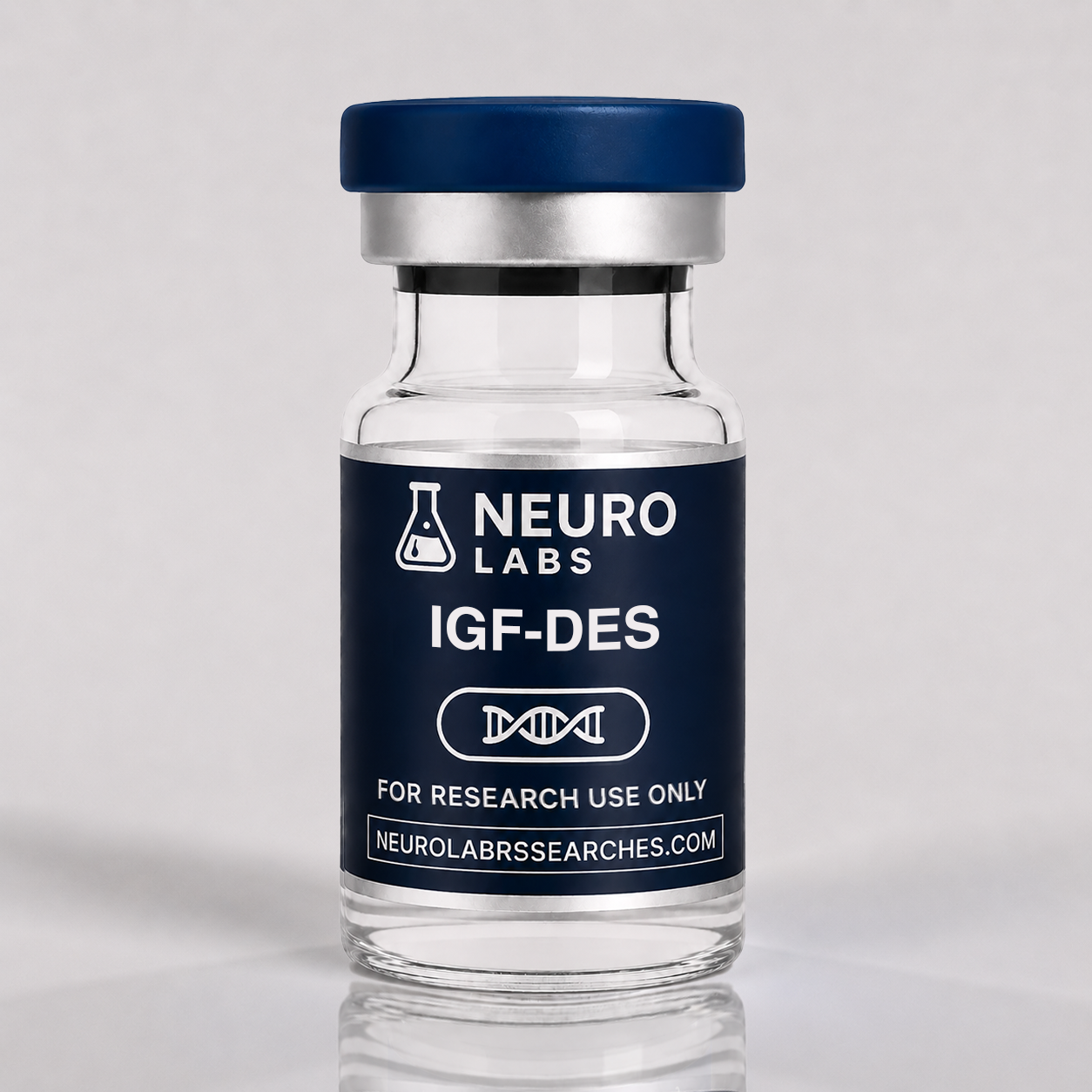
IGF-DES ®
Price range: $48.00 through $257.00
IGF-DES ®is a potent peptide analogue of Insulin‑like Growth Factor‑1 (IGF‑1), specifically designed with a truncated structure that enhances its biological activity. Known for its role in muscle growth, tissue repair, and cellular regeneration, IGF‑DES® is widely studied in peptide science, sports medicine, and regenerative research. This article explores its mechanism of action, dosage protocols, benefits, side effects, and research applications.
What is IGF-DES ®?
- Definition: IGF‑DES® is a shortened version of IGF‑1, missing the first three amino acids, which increases receptor affinity.
- Origin: Developed to enhance anabolic activity compared to standard IGF‑1.
- Research Use: Studied for muscle hypertrophy, recovery, and regenerative medicine.
Description
IGF-DES ®
IGF-DES ®is a potent peptide analogue of Insulin‑like Growth Factor‑1 (IGF‑1), specifically designed with a truncated structure that enhances its biological activity. Known for its role in muscle growth, tissue repair, and cellular regeneration, IGF‑DES® is widely studied in peptide science, sports medicine, and regenerative research. This article explores its mechanism of action, dosage protocols, benefits, side effects, and research applications.
What is IGF-DES ®?
- Definition: IGF‑DES® is a shortened version of IGF‑1, missing the first three amino acids, which increases receptor affinity.
- Origin: Developed to enhance anabolic activity compared to standard IGF‑1.
- Research Use: Studied for muscle hypertrophy, recovery, and regenerative medicine.
IGF-DES ® Mechanism of Action
IGF‑DES® binds to IGF‑1 receptors and activates downstream pathways:
- PI3K/Akt pathway: Promotes protein synthesis and muscle growth.
- MAPK pathway: Supports cell proliferation and differentiation.
- Satellite cell activation: Enhances muscle repair and regeneration.
Its truncated structure allows greater potency and localized activity, making it more effective in targeted tissue growth.
IGF-DES ® Dosage and Administration
.Standard Dosage
- Research protocols often explore 20–100 mcg per day, depending on study design.
- Administered via subcutaneous or intramuscular injection.
. Reconstitution
- Typically reconstituted with bacteriostatic water.
- Stored under refrigeration after mixing.
. Cycle Length
- Research cycles range from 2–4 weeks, due to IGF‑DES’s potency.
Benefits of IGF‑DES®
Muscle Growth
- Stimulates hypertrophy by activating satellite cells.
- Enhances lean mass development.
Recovery
- Accelerates healing of tendons, ligaments, and muscles.
- Reduces downtime after injury.
Regeneration
- Supports cellular repair in multiple tissues.
- Studied for potential neuroprotective effects.
Localized Growth
- More effective than IGF‑1 in site‑specific tissue growth.
Side Effects and Safety
Common Side Effects
- Injection site irritation.
- Mild headaches or fatigue.
- Water retention.
Serious Risks
- Hypoglycemia due to insulin‑like activity.
- Potential for abnormal cell growth.
- Contraindicated in individuals with active malignancy.
Long‑Term Considerations
- Limited human data on chronic use.
- Monitoring of IGF‑1 and glucose levels recommended.
Research Applications
Sports Medicine
- Studied for performance recovery and muscle repair.
Regenerative Medicine
- Potential applications in tissue engineering and wound healing.
Neurology
- Investigated for neuroprotection and cognitive support.
Comparison with Other Peptides
| Peptide | Mechanism | Focus |
|---|---|---|
| IGF‑DES® | Truncated IGF‑1 analogue | Localized muscle growth, regeneration |
| IGF‑1 LR3 | Long‑acting IGF‑1 analogue | Systemic growth, extended half‑life |
| BPC‑157 | Gastric peptide | Healing, anti‑inflammatory |
| TB‑500 | Thymosin beta‑4 fragment | Tissue repair, angiogenesis |
Frequently Asked Questions (FAQ)
1. What is IGF‑DES® used for?
Primarily studied for muscle growth, recovery, and regeneration.
2. How is IGF‑DES® administered?
Via subcutaneous or intramuscular injection after reconstitution.
3. Is IGF‑DES® safe?
Generally well‑tolerated in research, but risks include hypoglycemia and abnormal cell growth.
4. What makes IGF‑DES® unique?
Its truncated structure enhances potency and localized activity compared to IGF‑1.
5. Can IGF‑DES® be stacked?
Research sometimes explores combinations with BPC‑157 or TB‑500 for synergistic healing.
🔬 Scientific Background
- Molecular structure: Explain how IGF‑DES differs from IGF‑1 and IGF‑1 LR3 at the amino acid level.
- Binding affinity: Discuss why the truncated form increases potency.
- Half‑life: Compare IGF‑DES’s shorter half‑life with IGF‑1 LR3’s extended activity.
📊 Clinical and Research Data
- Summaries of animal studies showing muscle hypertrophy.
- Human trial data (if available) on recovery and regeneration.
- Comparisons of localized vs systemic effects.
🏋️ Applications in Sports Medicine
- Performance recovery: How IGF‑DES accelerates healing after intense training.
- Bodybuilding protocols: Research interest in hypertrophy cycles.
- Injury rehabilitation: Tendon and ligament repair potential.
🧠 Regenerative Medicine & Neurology
- Neuroprotection: IGF pathways in brain health.
- Stem cell activation: Role in tissue engineering.
- Anti‑aging research: Potential longevity applications.
⚖️ Safety and Monitoring
- Hypoglycemia risk: Explain insulin‑like activity.
- Cancer concerns: Growth factors and tumor proliferation.
- Monitoring protocols: IGF‑1 levels, glucose, and liver enzymes.
📈 Comparisons and Stacks
- IGF‑DES vs IGF‑1 LR3: Potency, half‑life, and applications.
- IGF‑DES vs HGH: Mechanistic differences.
- Stacks with BPC‑157 or TB‑500: Synergistic healing protocols.
💡 Practical Considerations
- Reconstitution techniques: Step‑by‑step lab protocols.
- Storage guidelines: Refrigeration and stability.
- Cycle length examples: Short vs extended research cycles.
📚 Expanded FAQ Section
Add 15–20 detailed questions, such as:
- How quickly does IGF‑DES work?
- Can IGF‑DES be combined with other peptides?
- What are the signs of IGF‑DES overdose?
- Is IGF‑DES legal?
- What does IGF‑DES cost?
📊 Tables and Visuals
- Comparison charts of IGF‑DES vs IGF‑1 LR3 vs HGH.
- Dosage cycle tables showing different research protocols.
- Side effect frequency tables from trial data.
🌍 Market and Availability
- Where to buy IGF‑DES for research.
- Pricing trends in peptide markets.
- Global regulations: Legal status in US, EU, Asia.
Conclusion
IGF‑DES® is a powerful peptide analogue of IGF‑1, designed for enhanced potency and localized tissue growth. Its importance lies in muscle hypertrophy, recovery, and regenerative medicine research. While promising, side effects such as hypoglycemia and potential abnormal cell growth highlight the need for responsible use under professional supervision.
Related products
AOD9604 ™
Original price was: $150.00.$142.00Current price is: $142.00.
GHK-CU ™
Price range: $47.00 through $58.00